Saturday, July 27, 2013

A Book for Chicago Right Now

Like most educators in Chicago Public Schools, I am feeling exhausted and weary after this incredibly rough year. The strike was one thing, the budget crisis another, and now the 3,000 layoffs. Librarians were some of the main jobs on the chopping block, and our community is beyond angry - just resigned to disappointment in a school system that refuses to acknowledge the need for skilled 21st century educators. But the one thing that I keep being impressed by is how my laid-off colleagues are staying on message. I haven't heard a single educator ask, "How will this affect my pension?" Rather, they ask, "How will this affect our kids?" 

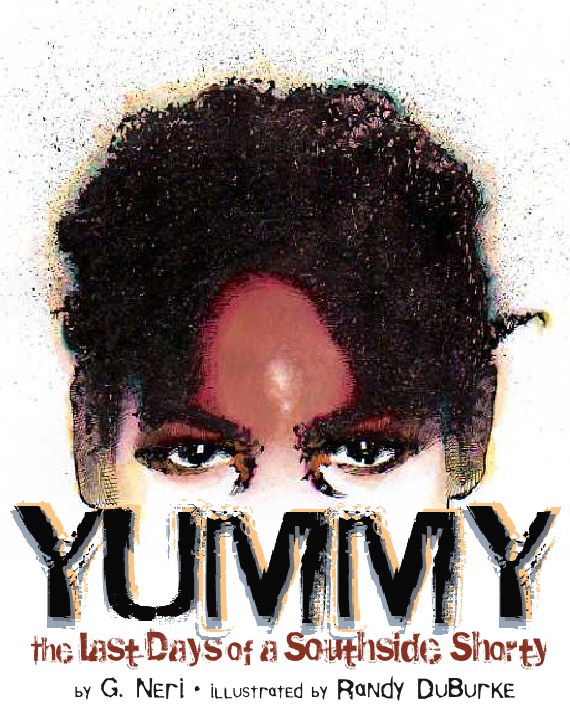
I just finished reading G. Neri's devastating graphic novel Yummy, the true story of Robert "Yummy" Sandifer. As a young member of the Black Disciples, Yummy made national headlines in Time Magazine when he shot and killed Shavon Dean in Chicago's Roseland neighborhood. He was 11, she was 14. The story is told by another boy named Roger, who gives us a complicated picture of Yummy. He's a reckless force who beats up Roger and shoplifts. He's a little kid with a squirt gun and a teddy bear, with a prostitute mother and a father serving time. After the murder, Roger seeks to answer one simple question: Why was Yummy the way he was? He gets answers from his classmates, his teachers, the news, and President Clinton himself - but he never gets a clear answer. Roger's own brother Gary is a member of the Black Disciplines Nation - what happens to his Gary after the story? I was chilled by the comparison given to Yummy by Monster, the leader of the Black Disciples: "Right now he's just a pit-bull puppy, but when he grows up, watch out!" The same gangsters who offered this boy solace end up shooting him in the head, to take the heat off them.

So whose fault is it when an 11-year-old joins a gang? Greg Neri doesn't specifically give an answer, but instead gives readers a large picture of the complicated community our kids are snarled in. I've been building relationships with kids in schools for a long time, and I want to clarify something for the reader: there are definitely "Yummys" out there, more than you know, and their pain is real. I'm just a librarian, and I'm not the person most qualified to discuss the topic, but I do know from my experience that for every "Yummy," there are many "Rogers" - amazingly curious, intelligent, resilient kids with the passion to stand up against a prescribed future. Children are not pit-bulls, they're humans. Please don't walk away from this story with a sense of devastation. Walk away from this story with the knowledge that children are powerful, and they have the power to choose.

Everyone in Chicago must read this, especially against the backdrop of school closings. Schools are the safe havens from gang violence, and often the one stable place in a kid's life. When they're closed, the good work of dedicated teachers is undone and children are endangered within the walls of the new schools. CPS teachers are fighting to give the children of Chicago the tools to build their own futures.

Do me a favor and sign the Daily Kos petition to Rahm Emanuel, telling him you prioritize the safety of our kids over a basketball arena for DePaul.

Extra Resources for Educators
- Vimeo: Book Trailer (AMAZING)
- Interview with Author G. Neri and Illustrator Randy DuBurke


Wednesday, July 17, 2013

A Love Letter to Neil Gaiman

I first heard Neil discuss The Ocean at the End of the Lane when I attended the 2012 Zena Sutherland Lecture at the Chicago Public Library. Amusingly titled "What the %$#& is a Children's Book?", Neil discussed how he delved into his childhood memories to write a story about a child for adults. In this story, a nameless protagonist revisits his childhood home after a funeral, and remembers the Hempstocks - a group of women with an "ocean"-pond in their backyard and ties to the mystical world. In the lecture, Neil discussed how we are protective of children's books, but that we rarely give children the credit they deserve for facing their fears through reading.

Right now, I am digesting Ocean.  I'll be honest and say it wasn't earthshattering, compared to my other favorites The Graveyard Book and the Shakespeare storyline in Sandman (the one that I could write a dissertation about). I don't really feel the need to pick it apart, but it has left me with a thoughtful note, as his work always does. The story's tone is elegiac, and the style reminded me strongly of American Gods. Neil's stories allow darkness to creep in through your nose like being underwater. He always reminds us that stories rarely contain flat "monsters" and "people." I felt it in Ocean - the characters are always a lot bigger on the inside than they appear. His child-characters are always so resilient too, which I love as a children's librarian. As a kid, I had to retreat into my imagination to deal with the things I couldn't understand to survive. My mind was a shelter from the things I couldn't deal with, and books were the bricks keeping me safe from the cold. As an adult, I sometimes forget the strength in my imagination. My library students are the ones who now bring me back home to that book-shelter whenever I need it. Great authors will always make you remember what's important to you, and give you the strength to fight for it. 


When I met Neil after the lecture, I was too starstruck to do anything other than to blurt, "MY FOURTH GRADERS LOVE GRAVEYARD, YOU HAVE MADE THEM READ." Even if it was awkward as hell, I'm glad I told him that one thing. (What else was I supposed to say? "Everything you write makes me love Humanity, Neil?") Because I love my students, and I always connect to the fact that they must be resilient, more than regular children, and we need more authors like Neil telling them it's okay to use your imagination and fight back against the strange monsters in this world.

We need you, Neil. Don't ever go away.

ETA: Did you know that Neil publicly confesses his love for librarians? SWOON.

Wednesday, July 10, 2013

Learning Management Systems... with GIFs!

UGH, GRADING. (Amirite teachers?) You have a zillion papers in front of you and half of these middle-schoolers didn't write their names. F's FOR ALL OF THE CHILDREN.


I HATE paper. Who does paper anymore? It's a huge waste for everyone, and it's easily lost - which is no good in these days of the portfolio/data-driven teacher. BUT, technology can fix it!! One of my goals this year is to do a better job at grading - or, like a tech geek, find a way to automate it so I can check myself. This is where Learning Management Systems come in. LMS's are websites where students can submit work and manage their content digitally. (So if you're a recent college grad, you're probably familiar with Blackboard or Moodle.) LMS's are awesome for all three groups in a school:

For Us: They can automate our grading, and collect evidence of learning to share with parents. All of your grades and assignments are easily composed and compiled in one place. AND you can differentiate more easily by sending out different assessments to user groups. HELLO SOMEBODY. 
For the Kids: Make it easier for the kids to track their progress. They get immediate feedback, too! No surprises at the end of the quarter! No excuses for incomplete work! 
For Parents: No more angry phone calls, because they can check child's progress online - often from their PHONE.


Here are 4 popular LMS's that I've implemented: 

1. Flubaroo Scripts for Google: Many school districts use Google Apps for Ed, or integrate Chromebooks. If you send out Google Forms from Drive for assessments and Exit Tickets, you probably have to do a lot of grading still because you have to read the submissions. Add Flubaroo scripts to automate the grading! 
***FREE.

2. Edmodo: I used Edmodo in my library, and my colleagues use it in middle-school stations. This is "Facebook for School", and it has a lot of app integration. The layout is also really manageable for students who are overwhelmed by website layouts. 
***FREE, but first check with your Tech Coordinator to see if your district has a license - we need the special Chicago Public Schools code to use it on our wireless. 

3. Schoology: Schoology is a lot like Edmodo, but fancier. It seems to work a lot better for iOS, and to me, the layout is more attractive for middle-school and high school. 
***FREE.

4. Project Foundry: For those of you with budgets (maybe?), an arts high school colleague just showed me Project Foundry, which is a portfolio project-tracking program/learning management system. It reminded me of IB because it enforces a lot of reflection and planning in the "process." I also like that it seamlessly integrates Google Apps. 
***This one isn't free!!

Now go forth and transform your grading time, super teachers! 


Tuesday, July 9, 2013

Inquiry Project: Make a Shoe

This Design activity was originally facilitated by Jason Reagin at the Texas IB Schools Workshop, but I'm totally inspired by it (coughSTEALINGITcough) and using it as a big opening for a unit on sustainable materials. :)

My colleagues were divided into groups of three, and given the task: make a shoe that works. Seems pretty crazy, right? I first thought of companies like TOMS, who make simple shoes that support sustainability in other countries. Since IB is about thinking globally, I also made a world connection to how the USA wastes textile materials like rubber. As the Librarian/Tech person, I want my students to think about waste and recycling, and to develop a problem-solving disposition towards this nebulous problem. 

In Jason's session, we were challenged to take on the role of the students and experiment with the IB Design Cycle to facilitate critical thinking. I have written this post as a "reflective lesson plan" that addresses standards/content from the IB MYP Unit Planner, so if you have any questions, please leave them in the comments. I'm also brand-new to IB, so I invite all feedback, even if it's just "hey librarian, that makes no sense."

The Challenge: How can you make a functional and appealing shoe that has at least 1/2-inch sole? (Only parameter!)


UNIT INFORMATION

Key Concept: Systems - making students think about how recycling systems affect the world    
Related Concepts:  PE/Health (adaptation/environment)
IB Area of Interaction: Approaches to Learning
Branch of Technology: Materials
Inquiry Questions:
Factual - What happens to our shoes when we're done with them?
Conceptual - How can we reduce the volume of non-biodegradable textiles in landfills by making more environmentally-sustainable (or biodegradable) shoes?
Debatable - Will people actually buy these shoes?

INVESTIGATIVE INFORMATION: 
According to The Environmental Protection Agency, only about 15% of post-consumer textiles (such as shoes, clothes, bags and belts…) enter the recycling stream, while 21 billion pounds – about 70 pounds for each person on Earth – ends up in landfills each year. 

Thank you Girl Scouts of Atlanta - this is a great facts sheet!

Measures of Success
1) Function - does it work? and 2) Overall appearance - is it attractive?

Given Materials:
 6 file folders, 1 glue stick
When I asked if we could use other materials, our presenter Jason gave me the sly response of, "These are the only materials I'm going to give you." This sort-of winky permission allowed my partners and I to go digging in our bags for other things, which I think would be engaging for kids.
***Added Found Materials!: Stapler, Paper Towels, Scissors
Drafting process.
Inquiry Process: Flummoxed with the materials, my team started with Google Images as a tool for inspiration. My team had two people with a fashion background and engineering, which gave us a small leg-up on the beginning part of the inquiry process. My background in graphic design wasn't helpful at this point, because we were focusing on functionality, not aesthetics. We first decided a target audience (who the shoe would be for), and also the function of the Shoe. These were important inquiry questions before even starting, and a facilitator may have to guide middle-schoolers to think about this before starting. We decided on making some comfortable menswear, since everyone else around us were making elaborate sandals.

Next, we had to struggle through the 1/2-inch sole parameter - how do you accomplish that with paper? So we experimented with "springs" made out of file-folder cardboard, but found that they weren't strong enough to sustain the weight. I think we experimented
too much here, which could eat up students' time.  However, we jacked some paper towels from the bathroom (found materials!), and found that rolling them had a similar "airwalk" quality that the springs had.
Failed springs, composition of the sole. 
Final Prototype: We decided to market our final product as "Cloudwalkers" - a reference to our base material. Easy to slip on after working out - walking on a cloud, weathering the storm! To model the product, our whole session had a fashion show to show off our products, which could be an awesome culminating activity for the unit.
You KNOW you want to buy these!

Formative/Summative Assessments: I would strongly focus on the Year 1 "Investigate" criteria when assessing, because it's my content area as a Teacher-Librarian. I want students to effectively frame the problem, because my kids often have zero background information for global issues. They need that info before they even begin to solve the "problem," which is that we produce shoes that aren't biodegrading in landfills. The Formative Assessment would be plugging in the research, which I would likely have the kids submit to me through Edmodo. The Summative would be developing a design brief, which is where I would plug in my Element of Choice. Giving students choice in design brief gets those aesthetic students on board if they're not good at physically making the shoes, like me. I obviously blogged for my design brief for this assignment, but another group made a fabulous iMovie with their iPad. 

- 2 minute iMovie
- Google Presentation

Reflection/Overall Impression of the Activity: This is a super high-engagement unit I would definitely want to implement. I totally see this activity translating from adults to middle-schoolers. The inquiry process is a critical part of the lesson, it's an authentic design task, and it has so much potential to connect to global topics.

For a Library?: Projects like this transform School Libraries into Makerspaces, which is a great direction. It positions the Teacher-Librarian as a facilitator, not a gatekeeper (!!), and gives them the opportunity to support STEM content. (Since everyone thinks we all read picture books.) The 21st-Century T-L can use both devices and books to drive the research process: they can put students on computer-based research, and also put out nonfiction texts about shoes, cultural dress, or engineering material.

Wondering: I wonder how the activity changes if you add more "parameters," so to say. The instructor will likely get more creative results if they give fewer parameters, but some students really need the parameters to stay on task.

Monday, July 8, 2013

PD Time: Texas IB Schools Conference


Greetings from fabulous Austin, Texas - the furthest South I've ever been in the continental United States. (I was told by the Southerners Florida doesn't count. Must be its own beast.) The humidity/heat is destroying my delicate vampire librarian skin, but Texans seem to love frigid air-conditioning.

Anyhoo, my colleagues and I are here for the Texas IB Schools Workshop, because our school is an IB school! Because IB is super-nebulous, here's a brief FAQ.

What is IB?
That acronym stands for "International Baccalaureate" - an international school curriculum that "aims to develop inquiring, knowledgeable and caring young people who help to create a better and more peaceful world through intercultural understanding and respect." It emphasizes holistic learning, to produce students who are "world citizens" through the Learner Profile.

What am I here for?
Schools get IB-certified by the organization, and ours happens to be one of them. I am implementing the Technology content of the Middle Years Programme (soon-to-be-renamed as "Design") in my classroom.

Where does a librarian fit in?
I'm the only librarian in my session, but there are several different contents represented here: Consumer Ec, traditional Tech, Humanities, Math, and Science. How cool is that? School librarians are natural collaborators, and it's awesome to be in a room with of all these people to hear about how I can better meet their needs.

For the confused people, this content area isn't about necessarily about applying "devices" - it's about inquiry. (A librarian's natural domain!) IB's Tech/Design content is about using your brain to solve big challenges. It's about saying, "We don't know how to do this yet. So how can we collaborate, use prior knowledge, choose tools, and follow through on responsible action to solve the problem?" 

Why am I excited?
I am SO pumped to bring this to my middle-schoolers, and emphasize more project-based learning in my Library. For me, it's about making my Library into a Makerspace.  I get to completely redesign my practice and emphasize that Libraries are welcoming places for all ideas. I get to tell students, "When you find your passion, you're unstoppable. You can solve any problem if you look hard enough for an answer." What could be more exciting for an educator?

Things to Share/Best Practices
* We watched this brilliant short film called Solve for X, which was about problem-solving. The humanity-loving part of me gets choked up over these things. Great thing to share in a classroom.
* Colleagues showed off two projects: the Mousetrap Car and the Shoe Inquiry. Both of these are cool enough for their own blog posts, and I'm TOTALLY stealing both activities.

Sunday, June 30, 2013

ALA 2013!

You know where ALA's HQ is, right? :)

Yesterday was  my first ALA Convention, hosted at McCormick Place! For those of you who don't know what ALA is, it's the annual convention hosted by the American Library Association. Basically, it's San Diego Comic Con, but for librarian's best practices, and a celebration of the relationships between librarians and the literary world. My star-struck self had an awesome time, described below.


Cool Things I Saw

1. The ALA Store: Wanted to buy all of the things. Some librarians have credit card problems, okay?

2. Graphic Novels!: Jon Scieszka (who is a RIOT and one of my all-time favorites) moderated a session on kids' graphic novels with Raina Telgemeier, Jarrett Krosoczka, and Doug TenNapel. Ms. Telgemeier was gracious enough to personalize a copy of Drama for my student who adores her. A 7th grader is about to be very happy!

3. Edwards Luncheon: Best of all, I attended the Margaret Edwards Luncheon, to honor the body of work put out by the venerable Tamora Pierce. I say "venerable" because of the immense respect I have for this young adult giant. Ms. Pierce is known for her fictional realm Tortall, inhabited by heroines like Alanna of Trebond, Daine Sarassri, Kelandry of Mindelan, Beka Cooper. The Circle of Magic series saw her rise to even greater heights. She writes diverse stories about girls who face tyranny, war crimes, misogyny, changing bodies, sex, racism, and everything else women fight. For the past 25 years, she's destroyed gender roles with a smile. Without her work, YA wouldn't be the female-friendly zone it is today. I wouldn't be the warrior I am today.

My mother read me Alanna's Song of the Lioness series when I was in third grade, and I've reread it dozens of times into adulthood. At the time, I wrote her a letter and she wrote me back, saying I was one of the youngest people to ever write to her. I've held onto that letter since. Later, a fellow GSLIS student met Tamora and sign a book for me, saying "Hi Kristy, what are you doing now?" (Thank you again, Eti.)

I attended with two colleagues: the aforementioned GSLIS alum, and my mentor librarian who recommended me SoL back in the day. First, Tamora punked the audience by pretending to be a doddering old lady, but then laughed at us all and launched into a brilliant speech describing her frustrating childhood full of male heroes. In the spirit of "Write the book you want to read," Tamora decided to write fantasy books about heroines who weren't princesses, but knights and soldiers and policewomen. Her books resonate with me and other women who take on physical roles protecting others, and who mentor other women who want to make change. ALA, I need for you to put up a transcription of this speech ASAP!

Attending the session with my mentor librarian, Stephanie, was extra special. Steph pushed me up to meet her, despite the fact that I was already reduced to tears by her speech. Wordlessly handing her that letter seemed to be pretty overwhelming for the both of us. Because I was shamelessly bawling, Steph had to talk and tell her my story. Such a special moment for all three of us.

My experience with Tamora Pierce reinforced several things for me:
- Librarians and educators must help children build relationships with authors. Author studies should be a critical part of emergent literacy.
- Text-to-self connections are an instant win for readers.
- Seeking mentors is an important life skill. Becoming one is the way you repay the favor.

I wish you could see TP's pendant: a double-edged battle axe. WIN.

ETA: Here is School Library Journal's writeup of the event, summarizing some of the best points. 

Sunday, June 23, 2013

Classroom Libraries & Leveling

Classroom libraries are always hot mess, period. See the pic -- accurate to how my school library feels sometimes. I don't know a single teacher who doesn't bemoan the process of keeping their classroom library stocked, organized, and properly leveled. (No matter how many times you buy the Wimpy Kid books, you'll never end the year with them...)

BUT, it doesn't have to be this way! Want to automate your systems for next year and level quickly? Check out the following apps and services below! 


CLASSROOM LIBRARY CHECKOUTS


BookSource Classroom Organizer (web, iOS, Android): For the teachers who are jealous of librarians with a scanning system! Paired with a cheap barcode scanner, the BSCO web service and phone app "allows users to maintain and inventory books and eBooks in their classroom library." I have a colleague in 2nd grade who already uses it, and we're adding it to our leveled book room next year, because teachers can check out items right from their phone. I highly recommend it! 


Delicious Library (iOS): For the Mac/iPad teachers, this personal library app may also be very helpful in the classroom - especially if you're trying to see the total value of what your library is worth or want to integrate your iTunes account. 


GoodReads (web, iOS, Android): Full disclosure - I'm personally addicted to GR, see the sidebar. However, social media apps like GR, Shelfari, and LibraryThing can serve an excellent role in the connected classroom, because you can use the tags to catalog your classroom library. You can even have students create a tag of their own name and tag a book when they read it, or add reviews through comments. 


LEVELING


The Book Leveler App (iOS): Here's an iPhone app to help teachers do summer leveling on Guided Reading, or may be helpful to share with parents who frequently take their children to the library. 


Scholastic Book Wizard (web): An old go-to. This service has improved over the years to include Lexile and DRA a well as Guided Reading, but it's limited to only titles offered by Scholastic. 


Have a favorite leveling app or classroom library suggestion? Leave it in the comments! 

Sunday, December 30, 2012

LINKSPAM: Readers' Advisory Resources

I'm cleaning up my in-browser bookmarks. I've been agonizing over whether to use Diigo, Delicious, or just plain Google Bookmarks. Basically, I'm angry that you can't make sub-folders or sub-lists in any of them. So, I decided to start using my blog more effectively to collect links I like, especially for Reader's Advisory.

TODAY'S LINKSPAM: READER'S ADVISORY RESOURCES!


Children's Literature


Database of Award-Winning Children's Literature: Research purposes.


How To Find Good Children's Lit: A thorough lists of all of the awards from professional associations. I used it to buy all of the Pura Belpre award winners, and keep referring back to it. (Courtesy of Philip Nel, Nine Kinds of Pie.)


Juvenile Series & Sequels Database: The most helpful link in the ENTIRE WORLD if you're on a reference desk and don't know what order the Wimpy Kid books go in.


Radical Children's Literature Now: List of books that teach children to question authority. Vigilante Librarian is a big fan of this. (Courtesy of Philip Nel, Nine Kinds of Pie.)


School Collection: Children's Lit (UIUC): My lovely library school created this for research purposes. 


S.A.L.S.A. (CPS Dept. of Libraries): The DOL @ Chicago Public Schools works so hard to create equitable lists for our ELL students. This is a great resource for school librarians like myself. 


Graphic Novels


Best Graphic Novels for Children (Goodreads List): As an avid Goodreads user, I'm a troll of these kinds of lists. 


Graphic Novels 4 Girls: A website that gets girls into comics? Love it! Searchable by genre.

Short Takes: 27 Graphic Novels for African American History Month:
I serve children of color, and I used this to help find materials to make my collection chromatic. My students deserve to see themselves in comics. Via Library Journal. (Related: From Aya to Zapt! and Holy Black History Month!)


Young Adult Lit


100 YA Books for the Feminist Reader:  BITCH Magazine, it's like you know me.


SYNC: "SYNC offers free Young Adult and Classic audiobook downloads to introduce the listening experience." YESSS.


Top 100 Banned Books, 2000-2009: I printed ALA's list out for my 8th graders last year and let them go to town. There is no better way to get a teen to read a book than to tell them they can't read it.


#YA Saves: Not technically a list, but if there was a battle cry for YA, this is it. Sherman Alexie laid the smackdown in the Wall Street Journal. I also had 7th/8th graders read this, and we bonded. They also actively sought out every book he mentioned in the article.

Saturday, March 17, 2012

BOOK REVIEW: The Curious Incident of the Dog in the Night-Time

 The Skinny
The title is actually a quotation lifted from the "Silver Blaze" story in The Adventures of Sherlock Holmes.*  The protagonist, Christopher Boone, is a 15-year-old boy on the autism spectrum who discovers his next-door neighbor's dog murdered in her yard. He decides to play detective and solve the murder. Throughout the story, Christopher uncovers a few more mysteries surrounding his parents and his father's true relationship with his neighbor. 

The Good
This book resonated strongly with me, as you'll below in my super-emotional life story. (Sorry in advance.) I usually avoid this type of "literary" fiction because I get really cynical about making emotional connections with the characters. But, I genuinely connected with Christopher, and I could see a high-YA audience connecting to it too. A cynical reviewer on Goodreads said that it's the gimmicky type of book that's written to go begging for awards, but I think the awards are deserved. It's creative. More importantly, the topic is treated respectfully.

What I most appreciated about this book is its compassionate depiction of Christopher's parents (from his POV, at least) as a pair of low-income, less-educated people struggling to understand how to help their son. Low-income families really struggle with the financial burdens of disability. I can't say how it is in the UK with socialized healthcare, but I know here in the US, insurance companies are obviously quite evil about covering preexisting conditions. And if you don't have federal insurance... well, you're fucked.If you don't have the luxury of a Special Education program at your public school, or the finances to have specialists treat your child to testing and tutoring, what can you do?

* And you thought I was getting tired of this Sherlock shit. How wrong you are.

Feminism/Life Points for "Curious Incident":
+1 for building understanding around autistic youths
+1 for depicting the financial burden of disability
+1 for compassionately depicting the emotional difficulties of a family with a differently-abled child

A lot of people will fight the first point out, though. For some reason, the publishers starting claiming that Christopher's character has Asperger's Syndrome and that was put on the cover, to Mark Haddon's chagrin. This is a publishing problem, not an authorial problem. 

My Main Contention: I really wanted to take away all points for a dog dying, because that's just not cool, you guys. I really can't deal with animals dying.


Personal Connection
I was fascinated by this book because as a teacher, I am working directly in child psychological development. I work with an autistic kindergartner, and I saw her echoed in Christopher. I'm glad I read this book, because it gave me some idea on how to approach this student, and any other differently-developed student. As a school practitioner, I still have a lot to learn about differentiating my lessons to meet those students' needs. My mother is a former Special Ed teacher (SPED, we teachers now call it), and my brother is a high-functioning ADD/OCD person, so I grew up fairly tolerant of what people call " mental disorders." (And what is an "ordered mind" these days?) I spend a lot of time picking our fantastic SPED team's brains, because SPED practice today is really beginning to shine.

I also felt a strong connection to this book because of how Christopher is treated as a savant. He's incredibly intelligent, and I love how the book showed that he could still function and perform well despite his mental handicaps. That same Kindergartner I work with struggles with social interaction, but her comprehension and other things aren't at all hindered by her autism. I want to punch people who would think her less-intelligent or stupid because of it.

Intelligence is such a fascinating topic to me. What kind of environment produces academic intelligence? I often consider how I've developed my own abilities, and why. I learned to read very quickly as a kid, with great comprehension and recall. I'm a good speller, and a knack for grammar, because I must have the innate "linguistic" type of brain. Not everyone can hear cadence and voice in their own writing, and I can. Why? I don't know.

On the other hand, I have certain compulsions - are they a product of intelligence, like Rain Man?  I am so compulsively organized with objects that when things are cluttered or disordered, I literally feel a cloud descending upon my mind. And to clear the cloud, I must clean shit up. I get extremely angry when people try to disorient, tease, or confuse me. When I lose things, I feel like I'm dying until I find them. I would weep horribly if I lost things as a kid, and I tried really hard to suppress this feeling by being organized.Whether this indicates me to have OCDish tendencies or not remains to be seen, I guess. ("No, I'm not OCD. I'm just Librarian." Haha.) I guess that mental stimulation is an addiction to me.

I also have a horrible fear of my mind deteriorating. Because I don't know about my genetics, this fear looms in the back of my mind. The idea of dementia in my old age terrifies me, because I value my mind above all else. I also suffer from depression, which I feel destroys my thinking abilities sometimes. I brushed my own emotional/mental borders before, when I was a teenager, and I used to have a serious issue with self-harm. I completely connected with what Christopher called his "Black Days" - except for me, it wasn't just days. It was months of fog and anger and buttloads of irrationality. I can't rightly parallel myself to Christopher or any other autistic person, but I can certainly understand how difficult it is to control one's moods based on the chemical whims of the brain.

I realized this fear last year, when my Aunt had an aneurysm. When she was operated upon to try to help the aneurysm, it popped and she was briefly in a coma. Now, she's lost control of one whole side of her body, and much of her mind. This Aunt was a SPED teacher as well, and one of the sharpest and most logical women I've ever known, so I see a tragic irony in the situation. It's haunting, and I feel such grief for her and my cousins. Now I think, what will happen to me in the future? What if one day I get in a car accident, and I lose control of my body forever? What if I became another Phineas Gage?

Nature Vs. Nurture?
I don't know if my skills are a sign of something unique, like an eidetic memory or me being a 3-year-old mnemonist. Generally, I think it's because I grew up in the right environment. I'm adopted, so I don't know if these skills are genetic, but I can attest to a lot of them being learned. My great-grandmother started reading to me incredibly early, which modeled reading as a behavior for me. As a librarian, I can see a huge difference in kids who read at home with family, and those who don't. I also had a mother who recognized a skill and nurtured it, and I went to a very wealthy public school that could differentiate instruction for me and put me in advanced-level classes.  My organizational talents were being put to use as a page in a library as young as age 11.

So am I "special"? Probably not. But think about how many other "special" abilities can be found and celebrated in children if they are nurtured! Young children have such fascinating, expandable developing minds. It's like playing with Play-Do with certain kids. I see a lot of special abilities hidden in my own students, who haven't had the privileges as me. When I was tutoring 1st and 2nd graders in phonics, I saw them rapidly improve their reading abilities. I saw an illiterate 2nd grader who could barely write his own name suddenly read fluently and become very successful as an independent reader - all because I gave him the personal attention 4 days a week. I wonder what could happen if he were given more attention.

So are special abilities innate, or learned? I don't know completely. But I do know that the human brain is  delicate and mysterious, and I love it. I love shaping my own mind, and watching children shape their own in my library.
Wednesday, February 15, 2012

Kindergarten Feminism

As a teacher, I try to tread with caution about the opinions I share with kids. I've mentioned my issues with middle-schoolers and homosexuality before, but the Kindergartners are a totally different ballgame.

The munchkins are different from big kids because they repeat without interpreting. This is the age where they start looking to adults for their affirmations and codes on many behaviors, including gender and racial roles. I spend some time thinking about what their racialized and gendered world looks like, and how I can reflect their world back to them positively in the books I provide for them in the Library/Media Center.

I had an amusing adventure in gender today. I did a readaloud in the Kindergarten class with Allie's Basketball Dream (Barbara E. Barber). It's the story of a young Black girl whose father buys her a basketball, only to be told by all of her unfeminist friends that girls do double-dutch and boys play basketball. But don't worry - Allie sticks it to all of her lame friends and shoots some pretty awesome baskets at the end of the story. Then, of course, everyone gets over their silly opinions and wants to play with her. Feminism and cooperation for the win! Check the breakdown on this:

Diversity Points for Allie:
+1 for a strong female character openly challenging a gendered opinion
+1 for the strong female character being non-white
+1 for a multiracial group of children depicted in cooperative, preexisting friendships
+1 for depicting an awesome, sensitive, and loving dad of color
+1 for boys and girls who change their unfeminist opinion on example and model inclusive behaviors
+1 for an urban environment that isn't the ghetto
6 Feminist Points! Barbara E. Barber, you are Feminist and Fabulous! Congrats on your inclusive entry into children's fiction!

All of this is awesome. Take this really lovely moment in the story where Allie takes down gender expectations across all sports:
"Well," Buddy snorted, "some guys think that girls shouldn't be playin' basketball."
 "That's dumb!" Allie bounced her ball. "My cousin Gwen plays on one of the best high school teams in her state. She's won more than ten trophies!" [...] "Some girls think boys shouldn't be jumping rope," Allie continued. "They think the boys are no good at it. That's dumb too."
Girl preach. So full of win, right? But when, I asked my Kindergarteners, "So, if girls can play basketball, can boys play double-dutch?" ... the answer was still a resounding NO. I didn't quite know what to do with this. First of all, some of the munchkins were clearly not listening to the author's message in the story! Basic fail, y'all.

Alas, one story isn't going to change the gender expectation already ingrained in these five-year-olds. My kids are bombarded with hypermasculine images of LeBron James and Derrick Rose. Their world offers an extremely narrow view of what adult (black) men do, other than basketball and rapping (and that one guy who is president). I'm fairly sure there's a weekly argument with a boy over their extremely unlikely future dreams of music or sports fame. And it's hard for them to understand, because that's all they know. I even think it's hard for the boys to concede that girls can enter a realm they so strongly consider theirs.

....Okay. I guess I get a little invested in the messages of children's books. But I'm hoping that today, I challenged some Kindergartenders' gender expectations today, made some girls feel like they could play sports, and made some boys feel like they could jump double-dutch.


Thursday, January 19, 2012

School Issue: LGBTQ Bullying

After seeing this article on Jezebel, and reviewing the source material, I feel the pain of my colleagues. There really is a huge bullying problem, and it's complex and difficult for American teachers to handle if their efforts aren't being reciprocated by their community. It doesn't help that public school teachers are constantly given a dumb, conflicting message about teaching equality values: "It's your job to mold these young people into  ethical participants in society - but don't mention ANYTHING EVER that's considered an 'issue' because you'll be forcing your political opinions on kids in a public school and we'll fire you." LGBTQ have their own set of snarls, especially when they intersect with other issues in the community.

So, personal example time. I'm a school librarian. I'm queer, which I will not reveal to my students. ("A queer school librarian! With tattoos! PROTECT THE CHILDREN.") When a student casually says something ignorant about sexuality, I wince. It happens less often - usually I'm correcting the standard "that's gay" stuff. I had an incredulous 3rd-grader explain to me how Lady Gaga is gay because of the way she dresses. I work in a religious African-American neighborhood, which has its own expectations about hyper-masculinity for the boys and other forms of alienation for girls. I often wonder if homosexuality is even discussed at all in my students' homes, as the dialogues of gay people of color have been long oppressed. Very few Americans have even heard of Bayard Rustin, despite his huge influence on Dr. Martin Luther King Jr. and black civil rights. I try not to assume that they come in with any knowledge. But where do I start? What's appropriate for me to say or do to promote understanding?
 
I obviously agree that educators should actively teach LGBTQ acceptance, but with tact: it depends on how the community feels about discussing sexuality. You have to balance being respectful of the community, but also do what you feel is right. I will be met poorly if I, as a white liberal, begin aggressively telling my students something different than is expressed in their church or their home. It would be wrong of me to tell a child their parent or an adult they trust is wrong.

Sigh. It's delicate, which I'm not always very good at.

None of this means I won't stand up for myself or my community, or avoid the issue. Here are my personal Rules of Thumb for dealing with slurs and commentary, while remaining professional: 

Do not engage. I coach middle-school poms, and 7th grade girls are universally horrible if you let them be. I shrug it off and say "it's none of my business, or yours" if students try to involve me in their gossip. Even shrugging and saying, "So?" is pretty effective. This is me modelling for them how to resist participating in the behavior. I know they're looking at me as an adult mentor and they come to me with gossip to be reaffirmed. They want me to react to them. I don't reaffirm their behavior, but I don't alienate myself as a person to take these issues to.

Tell kids to mind their own business! If the previous method doesn't work, I firmly tell a kid to worry about themselves and fix their own problems before they start pointing fingers at others. We live in an invasive, judgmental Mean Girls culture that loves to obnoxiously speculate about people we know nothing about. We as adults have to model that this behavior is wrong. Let's teach our kids to not be jerks.

Calmly explain, positively frame. I explain to students - without making them feel bad the first time - that calling someone a "faggot" feels oppressive on the level of the N-Word or any other slur to me, because my friends and family are gay. That peaceful dialogue is critical on the first try, because honestly, kids often say things without having any idea of what's coming out of their mouth. I'm going to immediately alienate that kid if I yell at them for calling someone a name without explaining the pain or history behind it. It's not fair to punish the child for not knowing the difference. I give them the opportunity to learn first. If it continues, then I more firmly intervene.

Set up a Zero-Tolerance Policy in Classrooms and Schools. No kid gets away with rudeness in my library. I'm very blessed to work at a school with a very united staff, who universally agree upon an aggressive zero-tolerance culture. And any anti-hate policy has to have firm consequences that are followed through. If you don't follow through, you've lost it completely. We deal with these problems on the spot, we don't just leave it to the Deans. It should be school-wide, and staff should have set-aside PD time to work on these policies. I think the GLSEN toolkit is very promising, and I hope my network will one day actively incorporate it into PD.
  .